Below are three sites, which depict and portray the forms of art found in the east asian religions we are studying in class. All these sites give good examples of the art forms, and explain how and why they relevant to the religions they represent.
Buddhism:
http://www.metmuseum.org/toah/hd/budd/hd_budd.htm
Taoism:
http://www.asianart.com/exhibitions/taoism/
Shintoism:
http://www.metmuseum.org/toah/hi/hi_japan42.htm
Wednesday, October 31, 2012

Spirited Away Movie Relevance Analysis
http://www.sparknotes.com/film/spiritedaway/canalysis.html
Above is the Sparknotes link which gives a detailed analysis on the Spirited Away characters. On that page are also links to other pages, which give insight to the symbolism found in the movie - through art, events, objects, and character representations. Historical context is also provided, along with explanation of the setting, mood, and influences on the film. A very good resource, that would help you completely understand the film.
"You read it here first: Obama’s economic recovery plan is entirely based on Spirited Away."
In contrast to the article above (which breaks down the movie in detail for us), this article suggests that the modern implications of this movie: the reflection of the movie's themes on the economy, politics, and finance. Interestingly enough, it also suggests Obama's recovery plan in 2008 is based on Spirited Away. For more details in the article itself, check out the link below. It's a good read! You won't regret it (:
http://www.flixist.com/deep-analysis-spirited-away-207051.phtml
Above is the Sparknotes link which gives a detailed analysis on the Spirited Away characters. On that page are also links to other pages, which give insight to the symbolism found in the movie - through art, events, objects, and character representations. Historical context is also provided, along with explanation of the setting, mood, and influences on the film. A very good resource, that would help you completely understand the film.
"You read it here first: Obama’s economic recovery plan is entirely based on Spirited Away."
In contrast to the article above (which breaks down the movie in detail for us), this article suggests that the modern implications of this movie: the reflection of the movie's themes on the economy, politics, and finance. Interestingly enough, it also suggests Obama's recovery plan in 2008 is based on Spirited Away. For more details in the article itself, check out the link below. It's a good read! You won't regret it (:
http://www.flixist.com/deep-analysis-spirited-away-207051.phtml
Spirited Away Movie Trailer
Spirited Away - This is the film that came up in the discussions we had about Shintoism during class. A very interesting film, that covers the many aspects of Shintoism as a religion in Japan. The gate that was discussed during class is evident in this video at approximately 0:24 seconds. I managed to find a video in English - enjoy!
Eastern Religions (Religion in Japan Video)
This is an informative, engaging, and interesting video about the two main religions in Japan (which we have covered in class as well) - Buddhism and Shintoism. This is a good introduction to some of the concepts and themes portrayed in both of the religions.
The Conversation - Justus, Su Jean, Jessica, Craig
Jessica: Shintoist
Su Jean: Buddhist
Craig Kim: Hindu
Justus Wah: Taoist
Shintoist: Hi guys. I was just wondering who you think God is? For me, I have many different gods. For example I have Amaterasu, the sun goddess,Tsukuyomi, the moon god, Inari, god of foxes, Kotoamatsukami, the primary kami trinity, Izanagi, the first man, Izanami, the first woman, Susanoo, god of storms, and Sarutahiko, kami of earth.
Buddhist: I don’t have any gods... Buddha didn’t believe in a god either. We really don’t think it’s necessary. Some claim that the belief in a god is necessary in order to explain the origin on the universe but science seriously just explains how the universe came into being without having to introduce the god-idea that every other religion has
Taoist: In my opinion, God is everywhere. God is everything. We embrace God in every moment of our lives, whether we know it or not. We call this concept the “Tao”. “Tao” is the way life is, and the eternal principle that governs the universe. Everything is in balance, and everything will fall into place. Feel it with your hands, and observe nature around you. Hear the beautiful sounds that surround you. God is everywhere!
Hindu: Hinduism is based mostly on three gods. Brahma, the creator of all things, Vishnu or Krishna the preserver of all creation, and Shiva, the destroyer.
Shintoist: Mmm, very interesting. I think it’s cool how we all have different gods. What do you guys think the meaning of life is? For us Shintoists, it is about living life in harmony with nature and society. We also try to do all things the best that we can with what we have. We like to focus on the beauty of life and our connection to nature.
Hindu: For us we consider the meaning of life to be a grand journey, the individual life moves through the various stages of development. These stages are Brahmacharya, Grihastha, Vanaprastha, and Sannyasa. After this all Hinduists hope to reach Nirvana, the place of salvation and liberation.
Buddhist: to end suffering, like it says in our Four Noble Truths! and to do that would be reaching enlightenment, by following the eightfold path, of course. I mean, nothing in this world really lasts does it? And because these things are going to eventually leave us, we fall into sorrow. We need to get out of the cycle of falling for things that we desire and ending up in suffering! Then I can finally stop being reincarnated and be in peace! … you can too
Taoist: The meaning of life? Well... I beg to differ! The concept of “Wu Wei” explains this perfectly! In life, everything will fall into place, and we will see the big picture soon. No action is required. “Tao” ensures everything is in order, and the meaning of life will soon be revealed to us through Tao.
Buddhist: who’s Wu Wei...?!
Taoist: Wu Wei is the concept of no action. Eventually, Tao (the natural way of life) will ensure that the many aspects of life will organize themselves, and see everything work out. To approach this idea, one could possibly assume the same mindset as that of your buddhist religion - having no desire. Without desires, there will be no action, and thus, no consequence. Without consequence, the natural flow of life will not be disrupted. I hope this answers your question, Buddhist.
Buddhist: oh well... yeah i guess. but desires always lead to suffering! so what, you want everyone to end up in suffering and pain?
Shintoist: I love hearing all these different answers! Connecting to this question what do you guys think the purpose of mankind is? I think for us Shintos it would be to live life the best that we can with what we have. I have always believed in that, and always will.
Taoist: The purpose of mankind is to observe. We are merely observers, given the wonderful opportunity of being able to see and feel the way of Tao, and everything falls into place. We are to embrace “Wu Wei” with all our heart, and let situations, people, objects, and circumstances work themselves out. Tao will take care of it, I promise. Let’s all sit back, and enjoy Tao’s work in progress!
Buddhist: exactly to fulfill the meaning of life! which was.. to end suffering. why would anyone want to suffer?!
Hindu: The purpose of mankind is summarized in four steps. Dharma, the fulfillment of one’s purpose, Artha, prosperity, Kama, desire and enjoyment, and Moksha, enlightenment.
Shintoist: Wow guys! Thank you so much for all your input. Just one more question I would like to ask. In your religion, what happens after you die? What is your after life?
Buddhist: An after life? A new life- i believe in reincarnations. you’re just born again in a cycle of lives and it keeps going until you learn how to stop desiring. then you’ll have no suffering = no pain = peace! :)
Taoist: Many Taoists like myself argue about what happens after life. Yes, it is unclear in our religion - However, everything will work out, no? In fact, we don’t have to worry. Tao has our paths set for us, and things will be alright. Many philosophies of death include transformation, and ascension into heaven. Other Taoists believe that death is the release of the corpse, and we are free to embrace Tao after death. This is similar to Nirvana in Buddhism.
Hindu: Oh, thats easy, if each person commits a bad deed after they die, they will be reincarnated into a lower worlds and suffer from the consequences of their evil actions. Or if you have performed good deeds you will be gladly accepted into a higher world, and you will enjoy life.
Su Jean: Buddhist
Craig Kim: Hindu
Justus Wah: Taoist
Shintoist: Hi guys. I was just wondering who you think God is? For me, I have many different gods. For example I have Amaterasu, the sun goddess,Tsukuyomi, the moon god, Inari, god of foxes, Kotoamatsukami, the primary kami trinity, Izanagi, the first man, Izanami, the first woman, Susanoo, god of storms, and Sarutahiko, kami of earth.
Buddhist: I don’t have any gods... Buddha didn’t believe in a god either. We really don’t think it’s necessary. Some claim that the belief in a god is necessary in order to explain the origin on the universe but science seriously just explains how the universe came into being without having to introduce the god-idea that every other religion has
Taoist: In my opinion, God is everywhere. God is everything. We embrace God in every moment of our lives, whether we know it or not. We call this concept the “Tao”. “Tao” is the way life is, and the eternal principle that governs the universe. Everything is in balance, and everything will fall into place. Feel it with your hands, and observe nature around you. Hear the beautiful sounds that surround you. God is everywhere!
Hindu: Hinduism is based mostly on three gods. Brahma, the creator of all things, Vishnu or Krishna the preserver of all creation, and Shiva, the destroyer.
Shintoist: Mmm, very interesting. I think it’s cool how we all have different gods. What do you guys think the meaning of life is? For us Shintoists, it is about living life in harmony with nature and society. We also try to do all things the best that we can with what we have. We like to focus on the beauty of life and our connection to nature.
Hindu: For us we consider the meaning of life to be a grand journey, the individual life moves through the various stages of development. These stages are Brahmacharya, Grihastha, Vanaprastha, and Sannyasa. After this all Hinduists hope to reach Nirvana, the place of salvation and liberation.
Buddhist: to end suffering, like it says in our Four Noble Truths! and to do that would be reaching enlightenment, by following the eightfold path, of course. I mean, nothing in this world really lasts does it? And because these things are going to eventually leave us, we fall into sorrow. We need to get out of the cycle of falling for things that we desire and ending up in suffering! Then I can finally stop being reincarnated and be in peace! … you can too
Taoist: The meaning of life? Well... I beg to differ! The concept of “Wu Wei” explains this perfectly! In life, everything will fall into place, and we will see the big picture soon. No action is required. “Tao” ensures everything is in order, and the meaning of life will soon be revealed to us through Tao.
Buddhist: who’s Wu Wei...?!
Taoist: Wu Wei is the concept of no action. Eventually, Tao (the natural way of life) will ensure that the many aspects of life will organize themselves, and see everything work out. To approach this idea, one could possibly assume the same mindset as that of your buddhist religion - having no desire. Without desires, there will be no action, and thus, no consequence. Without consequence, the natural flow of life will not be disrupted. I hope this answers your question, Buddhist.
Buddhist: oh well... yeah i guess. but desires always lead to suffering! so what, you want everyone to end up in suffering and pain?
Shintoist: I love hearing all these different answers! Connecting to this question what do you guys think the purpose of mankind is? I think for us Shintos it would be to live life the best that we can with what we have. I have always believed in that, and always will.
Taoist: The purpose of mankind is to observe. We are merely observers, given the wonderful opportunity of being able to see and feel the way of Tao, and everything falls into place. We are to embrace “Wu Wei” with all our heart, and let situations, people, objects, and circumstances work themselves out. Tao will take care of it, I promise. Let’s all sit back, and enjoy Tao’s work in progress!
Buddhist: exactly to fulfill the meaning of life! which was.. to end suffering. why would anyone want to suffer?!
Hindu: The purpose of mankind is summarized in four steps. Dharma, the fulfillment of one’s purpose, Artha, prosperity, Kama, desire and enjoyment, and Moksha, enlightenment.
Shintoist: Wow guys! Thank you so much for all your input. Just one more question I would like to ask. In your religion, what happens after you die? What is your after life?
Buddhist: An after life? A new life- i believe in reincarnations. you’re just born again in a cycle of lives and it keeps going until you learn how to stop desiring. then you’ll have no suffering = no pain = peace! :)
Taoist: Many Taoists like myself argue about what happens after life. Yes, it is unclear in our religion - However, everything will work out, no? In fact, we don’t have to worry. Tao has our paths set for us, and things will be alright. Many philosophies of death include transformation, and ascension into heaven. Other Taoists believe that death is the release of the corpse, and we are free to embrace Tao after death. This is similar to Nirvana in Buddhism.
Hindu: Oh, thats easy, if each person commits a bad deed after they die, they will be reincarnated into a lower worlds and suffer from the consequences of their evil actions. Or if you have performed good deeds you will be gladly accepted into a higher world, and you will enjoy life.
The Conversation - Junee, Vasundhara, Irissa, Rachel
Rachel: Buddhist
Junee: Hindu
Vasundhara: Confucianist
Irissa: Taoist
Who is God?
What is the meaning of life?
What is the purpose of mankind?
What happens after life?
Junee: Hi guys! I’m interested in learning about each of your religions and your various beliefs. Let’s start by talking about God. Who is God to you?
Irissa: Hi Junee, I believe in Taoism. My religion is a bit different than all of yours, mine’s more on a concept, or “philosophy” rather than an actual religion. We don’t believe in any particular God, we believe in the “Tao”, which is basically just the flow of life. We believe the Tao will lead us, to great things. Tao is just the ultimate reality. Basically a presence that was here before the Earth was even created. Into the olden days of my religion, we did have many Gods. Although the Gods were taken from other religions, not any from our own that we believe in.
Rachel: Well, in my religion of Buddhism, the Buddha stopped praying to the gods about ending the suffering of others, and oneself. The Buddha filled his world with many gods, the most important god was Brahma, the creator god. Buddhism does not believe in having a personal god or a divine being, it does not have worship, praying to, or praising of a divine being. It does not offer a form of redemption, forgiveness, no heavenly hope, or a final judgment to those practicing its system. It is not considered to be atheism because I do not believe in a personal god, it is pantheism, there is an impersonal force the void which is the ultimate.
Vasundhara: In my religion that is Confucianism, there is no God. The founder of this religion was a Chinese philosopher called Kung Fu Tzu, also known as Confucius, and he believed in the Great Ultimate (Tao). But he never implemented that into his concept of Confucianism. He made this religion humanistic that focused on building virtue and maintenance of ethics, primarily Jen which is respect for all individuals; Chun-tzu which is converting Jen into habitual action; li which is correctly living the 5 relationships that include ruler/subject, father/son, elder/younger, husband/wife and friend/friend; and Te which is to provide service and Wen which is to focus on the beautiful things of life.
Junee: For me, as a Hindu, the concept of God is one that is very complex. It really depends on the individual and their beliefs because Hinduism is a religion that encompasses many ideas and philosophies. However the complex concept of God can be boiled down to a Total Being that embodies enlightenment. Some noteworthy gods would be Vishnu the Preserver, Brahma the Creator, and Shiva the Destroyer. I also believe that at my innermost soul there is a hidden greatness called the Atman. The Atman is my connection to the Total Being.
Irissa: That’s really interesting! We all have different views on God. I can understand all the reasons why you guys believe in these Gods. I’m just curious, Junee, you believe in all of those things, and seem to be a strong believer in your concept of God, what do you believe to be the meaning of life then?
Junee: The meaning of life for me as Hindu would be to peel away at the layers of selfishness, ignorance, and worldly things in order to become one with my Atman. By doing this I would be able to reach Utter Reality which is the end of all suffering. Hinduism also teaches me to promote peace, forgive others, have compassion, and identify with the meek.
Rachel: In Buddhism, the primary purpose of life is to end suffering. The Buddha taught that the humans suffer because we continually strive to receive, or gain things that do not give up lasting happiness. The point that the Buddha was trying to make was not that there are not things in life that give joy, but he pointed out that none of them last and our attachments only cause more suffering. This is done by the recognition that things are impermanent and by freeing oneself from the attachments that lesson suffering and then later on end the cycle of rebirth. These teachings are expressed most concisely in the Four Noble Truths and The Eightfold Path, which together form the foundation of belief for all branches of Buddhism.
Irissa: For a Taoist, the meaning of life is to just live in accordance with the Tao. Live your life thinking about the positive flows of the Tao. Live in harmony with the natural ways of life, just going with the “flow”, which is the Tao. Our main purpose is to reach immortality. And this has many different meanings to that, and obviously reaching this is extremely challenging. We believe healthy diet, no sexual contact, and just behaving in a moral way. Interesting right?
Vasundhara: The meaning of life to me is to pay respect to all the individuals in the entire world and provide them with service such as helping them whenever they are in need, helping in organising charity and other services like that and be benevolent Also, to concentrate on things like music, poetry and art. Basically it is just to follow the five principles as mentioned earlier.
Junee: Despite the apparent differences, it’s stunning to see how similar our beliefs are. Although the specifics may vary, I’m sure that we can all see real value in the meaning and purpose of each other’s religions. So Vasundhara, what happens after life for a Confucianist?
Vasundhara: There is no particular answer to that question. Due to the emphasis laid on the the services done in ones lifetime, my religion never or Confucius never came up with an answer to that question. In my religion, afterlife is not given that much importance. So it is kind of difficult for me to answer that question. We Confucians focus on what we can do for the mankind rather than think about what happens after life.
Rachel: The Buddha described reincarnation, or taking on of a new body in the next life in a different way than the traditional Indian understanding. Salvation in early Buddhism was nirvana, the extinguishing of the karma that constitutes the self. Nirvana is not a place or state, but the end of rebirth. Buddha said very little about Nirvana, he had felt that the practice of ending suffering was far more important, and focusing on ultimate salvation would only lead to having more attachments, which would then cause more suffering.
Junee: In Hinduism we believe in reincarnation. When we die our souls are weighed and based upon that we are reincarnated into a different being. Once we become one with our Atman and reach Utter Reality, we are free from the cycle of reincarnation and reach Nirvana.
Irissa: Oh wow our religions are so different, it’s actually very fascinating. Well for Taoist people like myself, we don’t fear death. This doesn’t mean we desire or long for it in any way, but we just believe in living life to the fullest, with the Tao. We believe when we live, we live with the Tao. When we die, we still live with the Tao. Nothing changes. Honestly we really don’t concern too much about this, many chose to even not believe in an afterlife. They simply believe that the physical form may have died, but the spirit lives on, having reached the Tao with the Gods, which means they have reached immorality.
Junee: It’s been great talking to you guys about our various beliefs. This discussion has been both enlightening and enjoyable! Thank you!
Junee: Hindu
Vasundhara: Confucianist
Irissa: Taoist
Who is God?
What is the meaning of life?
What is the purpose of mankind?
What happens after life?
Junee: Hi guys! I’m interested in learning about each of your religions and your various beliefs. Let’s start by talking about God. Who is God to you?
Irissa: Hi Junee, I believe in Taoism. My religion is a bit different than all of yours, mine’s more on a concept, or “philosophy” rather than an actual religion. We don’t believe in any particular God, we believe in the “Tao”, which is basically just the flow of life. We believe the Tao will lead us, to great things. Tao is just the ultimate reality. Basically a presence that was here before the Earth was even created. Into the olden days of my religion, we did have many Gods. Although the Gods were taken from other religions, not any from our own that we believe in.
Rachel: Well, in my religion of Buddhism, the Buddha stopped praying to the gods about ending the suffering of others, and oneself. The Buddha filled his world with many gods, the most important god was Brahma, the creator god. Buddhism does not believe in having a personal god or a divine being, it does not have worship, praying to, or praising of a divine being. It does not offer a form of redemption, forgiveness, no heavenly hope, or a final judgment to those practicing its system. It is not considered to be atheism because I do not believe in a personal god, it is pantheism, there is an impersonal force the void which is the ultimate.
Vasundhara: In my religion that is Confucianism, there is no God. The founder of this religion was a Chinese philosopher called Kung Fu Tzu, also known as Confucius, and he believed in the Great Ultimate (Tao). But he never implemented that into his concept of Confucianism. He made this religion humanistic that focused on building virtue and maintenance of ethics, primarily Jen which is respect for all individuals; Chun-tzu which is converting Jen into habitual action; li which is correctly living the 5 relationships that include ruler/subject, father/son, elder/younger, husband/wife and friend/friend; and Te which is to provide service and Wen which is to focus on the beautiful things of life.
Junee: For me, as a Hindu, the concept of God is one that is very complex. It really depends on the individual and their beliefs because Hinduism is a religion that encompasses many ideas and philosophies. However the complex concept of God can be boiled down to a Total Being that embodies enlightenment. Some noteworthy gods would be Vishnu the Preserver, Brahma the Creator, and Shiva the Destroyer. I also believe that at my innermost soul there is a hidden greatness called the Atman. The Atman is my connection to the Total Being.
Irissa: That’s really interesting! We all have different views on God. I can understand all the reasons why you guys believe in these Gods. I’m just curious, Junee, you believe in all of those things, and seem to be a strong believer in your concept of God, what do you believe to be the meaning of life then?
Junee: The meaning of life for me as Hindu would be to peel away at the layers of selfishness, ignorance, and worldly things in order to become one with my Atman. By doing this I would be able to reach Utter Reality which is the end of all suffering. Hinduism also teaches me to promote peace, forgive others, have compassion, and identify with the meek.
Rachel: In Buddhism, the primary purpose of life is to end suffering. The Buddha taught that the humans suffer because we continually strive to receive, or gain things that do not give up lasting happiness. The point that the Buddha was trying to make was not that there are not things in life that give joy, but he pointed out that none of them last and our attachments only cause more suffering. This is done by the recognition that things are impermanent and by freeing oneself from the attachments that lesson suffering and then later on end the cycle of rebirth. These teachings are expressed most concisely in the Four Noble Truths and The Eightfold Path, which together form the foundation of belief for all branches of Buddhism.
Irissa: For a Taoist, the meaning of life is to just live in accordance with the Tao. Live your life thinking about the positive flows of the Tao. Live in harmony with the natural ways of life, just going with the “flow”, which is the Tao. Our main purpose is to reach immortality. And this has many different meanings to that, and obviously reaching this is extremely challenging. We believe healthy diet, no sexual contact, and just behaving in a moral way. Interesting right?
Vasundhara: The meaning of life to me is to pay respect to all the individuals in the entire world and provide them with service such as helping them whenever they are in need, helping in organising charity and other services like that and be benevolent Also, to concentrate on things like music, poetry and art. Basically it is just to follow the five principles as mentioned earlier.
Junee: Despite the apparent differences, it’s stunning to see how similar our beliefs are. Although the specifics may vary, I’m sure that we can all see real value in the meaning and purpose of each other’s religions. So Vasundhara, what happens after life for a Confucianist?
Vasundhara: There is no particular answer to that question. Due to the emphasis laid on the the services done in ones lifetime, my religion never or Confucius never came up with an answer to that question. In my religion, afterlife is not given that much importance. So it is kind of difficult for me to answer that question. We Confucians focus on what we can do for the mankind rather than think about what happens after life.
Rachel: The Buddha described reincarnation, or taking on of a new body in the next life in a different way than the traditional Indian understanding. Salvation in early Buddhism was nirvana, the extinguishing of the karma that constitutes the self. Nirvana is not a place or state, but the end of rebirth. Buddha said very little about Nirvana, he had felt that the practice of ending suffering was far more important, and focusing on ultimate salvation would only lead to having more attachments, which would then cause more suffering.
Junee: In Hinduism we believe in reincarnation. When we die our souls are weighed and based upon that we are reincarnated into a different being. Once we become one with our Atman and reach Utter Reality, we are free from the cycle of reincarnation and reach Nirvana.
Irissa: Oh wow our religions are so different, it’s actually very fascinating. Well for Taoist people like myself, we don’t fear death. This doesn’t mean we desire or long for it in any way, but we just believe in living life to the fullest, with the Tao. We believe when we live, we live with the Tao. When we die, we still live with the Tao. Nothing changes. Honestly we really don’t concern too much about this, many chose to even not believe in an afterlife. They simply believe that the physical form may have died, but the spirit lives on, having reached the Tao with the Gods, which means they have reached immorality.
Junee: It’s been great talking to you guys about our various beliefs. This discussion has been both enlightening and enjoyable! Thank you!
The Conversation
Emma : Hindu
Patrick: Shintoism
Alex: Buddhism
Eric: Taoism
ERIC: Who is God?
Alex: There is no god! Only the spirits in us all.
Patrick: There are many gods that dwell within nature, they are called kami. They are not the same omnipotent God of some other religions but our gods are rather just spirits of nature
Eric: HEY!!!!!!!! there is a GOD ALEX! , the god is called DAd from the religion of Taoism
Emma: There are many gods but there are three main ones. Brahma - the creator, Vishnu - the preserver, Shiva - the destroyer.
Alex: So there is some in wisdom in the Hindu ways. The impermanence of all things prevails into your religion too.
Patrick: I see that our religions differ, what is the meaning of life in your religions?
Alex: For us, a Nirvana, where we are free from all desires should be the goal of any life, and therefore is the meaning for which we all strive.
Eric: In taoism, Qi (or Chi) is also known as the “life force”, philosophical Taoist don’t really believe in life, but more of how people live in the universe
Emma: For Hindus, the goal and grounds for being is to reach Brahman or Ultimate Reality.
Patrick: For Shintos, we regard life as the realm where the divine spirit seeks to purify itself by rightful self-development. We want to prolong our life on Earth as a victory of our divine spirits
Emma: It seems that our religions have similar meanings of life, but are these the reasons why mankind exist? Is the meaning of life and the reason for mankind the same thing? We believe that the purpose of humans is to perform the proper sacrifices to the gods.
Alex: Mankind exists because we exist. But, it is important for you to live according to the Buddha’s teachings so we may find happiness.
Patrick: I see, what is the afterlife like in your respective religions?
Eric: Taoist believe that they can achieve immortality through completing many task in their life times.
Alex: Immortality doesn’t exist. We Die When WE DIE. Though there is the Dallai Lama’s reincarnation.
Eric: Well ALEX! Immortality does exist when people die and go to heaven after achieving life goals during their lifetimes.
Patrick: It is said that when we die, we go to a place called yomi, an underground realm with a river separating the living and the dead. It’s similar to the underworld in greek mythology
Emma: In hinduism, we believe that when we die we a reincarnated into different castes depending on how good we were in our previous life.
Patrick: Shintoism
Alex: Buddhism
Eric: Taoism
ERIC: Who is God?
Alex: There is no god! Only the spirits in us all.
Patrick: There are many gods that dwell within nature, they are called kami. They are not the same omnipotent God of some other religions but our gods are rather just spirits of nature
Eric: HEY!!!!!!!! there is a GOD ALEX! , the god is called DAd from the religion of Taoism
Emma: There are many gods but there are three main ones. Brahma - the creator, Vishnu - the preserver, Shiva - the destroyer.
Alex: So there is some in wisdom in the Hindu ways. The impermanence of all things prevails into your religion too.
Patrick: I see that our religions differ, what is the meaning of life in your religions?
Alex: For us, a Nirvana, where we are free from all desires should be the goal of any life, and therefore is the meaning for which we all strive.
Eric: In taoism, Qi (or Chi) is also known as the “life force”, philosophical Taoist don’t really believe in life, but more of how people live in the universe
Emma: For Hindus, the goal and grounds for being is to reach Brahman or Ultimate Reality.
Patrick: For Shintos, we regard life as the realm where the divine spirit seeks to purify itself by rightful self-development. We want to prolong our life on Earth as a victory of our divine spirits
Emma: It seems that our religions have similar meanings of life, but are these the reasons why mankind exist? Is the meaning of life and the reason for mankind the same thing? We believe that the purpose of humans is to perform the proper sacrifices to the gods.
Alex: Mankind exists because we exist. But, it is important for you to live according to the Buddha’s teachings so we may find happiness.
Patrick: I see, what is the afterlife like in your respective religions?
Eric: Taoist believe that they can achieve immortality through completing many task in their life times.
Alex: Immortality doesn’t exist. We Die When WE DIE. Though there is the Dallai Lama’s reincarnation.
Eric: Well ALEX! Immortality does exist when people die and go to heaven after achieving life goals during their lifetimes.
Patrick: It is said that when we die, we go to a place called yomi, an underground realm with a river separating the living and the dead. It’s similar to the underworld in greek mythology
Emma: In hinduism, we believe that when we die we a reincarnated into different castes depending on how good we were in our previous life.
Sunday, October 28, 2012
The Conversation
In a group write a conversation using Google docs, from the perspective of one of each of the Eastern Religions. For instance, one person in your group will be a Hindu, one a Buddhist, one a Confucianist, and the last can choose Shinto or Taoist. During this conversation, answer these questions:
Who is God?
What is the meaning of life?
Why does mankind exist?
What happens when we die?
Be sure to answer from the perspective of your chosen religion and, as in any conversation, feel free to ask questions of the other people for clarity of their religions.
Once this is completed, copy and paste this conversation as a NEW POST onto the blog.
Friday, October 26, 2012
Joking around with the Dalai Lama
The Dalai Lama is known to be one of the inspiration and important man to the Tibetan Buddhists. However, as Karl from "Today" tries to humor the Dalai Lama, it endes up as the joke being a complete failure and Karl making a fool out of himself.
Uposatha- observation day
.jpg)
Uposatha, pronounced as Upavasatha, is one out of my traditions in Buddhism. It is known as a day of observation and was founded during the age of the Buddha. It was practiced when it was the last day of the month, with the bright full moon in the sky. Uposatha was particular made for cleansing your degraded mind by gathering monks and people to meditate the whole day. This was called laying practice. Although in this picture most people are sitting down, it was called laying people because they wanted Buddhists to feel confort as if they were comfortably lying down. However, with full practice, one would achieve inner peace and joy.
Personally, as I was reading about Uposatha, I realized that meditating was on different levels of difficulty. Although I did not believe in Buddhism, I decided to practice meditating the whole day. However, after about 3 minutes I was already falling apart with bored thoughts and easily becoming distracted. With irrelevant thoughts, I suggested to stop meditating. This was when I realized that meditation was extremely difficult, and Uposatha was something not any ordinary people could practice. Instead it was something that had to be developed and mastered for years.
Sources:
http://en.wikipedia.org/wiki/Uposatha
Picture:
http://www.capetownmeditation.com/images/18/Uposatha_Day_(2).jpg
Wednesday, October 24, 2012
Smile! :)
It is
often advised to put on a half smile while meditating. Why is this? Is it a
natural state for us as humans? What makes it so beneficial to meditating?

Smiling
is associated with positivity. When we smile it just tends makes everything
better. It makes others around us happier and more positive. If you smile while
you are meditating it can help you realize what around you you are smiling
about and will give you a more positive view on the world.
Dalai
Lama says that he is a professional laugher even though he has faced many
difficulties in his life. His simple family lifestyle in a small village has
helped him be more jovial as his family were always amusing themselves and
teasing each other.
“Of course problems are there. But
thinking only of the negative aspect doesn’t help to find solutions and it
destroys peace of mind. Everything, though, is relative. You can see the
positive side of even the worst tragedies if you adopt a holistic perspective.” – Dalai Lama
 This is a very important thing to
look at, I think, especially in this day and age. It seems like because of
technological and scientific advances, we have everything we could ever want in
life yet we are never happy. I mean depression rates are increasing every year!
Dalai Lama and his people have lost their country. He’s homeless. But he still
smiles and laughs everyday because he looks at the positive points of his
situation (like meeting new people and travelling all around the world) rather
than the negatives. This has helped him preserve his inner peace.
This is a very important thing to
look at, I think, especially in this day and age. It seems like because of
technological and scientific advances, we have everything we could ever want in
life yet we are never happy. I mean depression rates are increasing every year!
Dalai Lama and his people have lost their country. He’s homeless. But he still
smiles and laughs everyday because he looks at the positive points of his
situation (like meeting new people and travelling all around the world) rather
than the negatives. This has helped him preserve his inner peace.
“An authentic smile
arouses an authentic feeling of freshness, and I think the smile belongs only
to human beings. If we want those smiles, we must create the reasons that make
them appear.”
Cites:
http://www.reddit.com/r/Buddhism/comments/11zpkw/is_the_half_smile_the_natural_relaxed_state_of/
http://www.thedailybeast.com/articles/2010/10/24/dalai-lama-on-laughter-and-compassion.html
Tuesday, October 23, 2012
Patience and the Eightfold Path
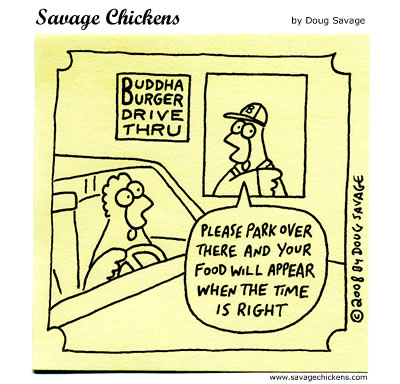
This picture is about the patience and the reward that you achieve after meditating within Buddhism. As it is shown above, the chicken with the McDonald hat describes that when you fully master the Eightfold Path, you will proudly collect your prize. That is in this case a hamburger. However, this picture also infers that waiting patiently will not be easy, as the Eightfold Path will be very difficult along the way.
Monday, October 22, 2012
Eastern Religions Art Project
**Please see Edline for Eastern Religions Power Point
Due: October 29th, 30th
1.
Choose one of the art forms we discussed
in class coming from either: Hinduism, Buddhism, Confucianism, Taoism, or
Shintoism.
2.
Research that art form. Why was it used?
What are the different elements to that art form? What part of the religion
influences the art form?
3.
Create an artistic display of this art
form. Dimensions should not exceed 24”x24”, but should not be less than 6”x6”. You
may use video or music as an art form as well.
4.
Write NO MORE than a one-page caption of
your creation.
a.
Why did you choose this art form?
b.
What religion influenced this art form?
c.
What are two religious principles that
are evident from the art form?
d.
If there is any translation that needs
to be made, explanation of color usage or other unexplained portions, do so in
this page caption.
Total points: 50
1 page Caption: 25 points
Artistic creation (neatness, effort, excellence, NOT
artistic ability): 25 points
Saturday, October 20, 2012
wHaT Is REiNcarNaTioN?
 Buddhists believe that human beings are constantly giving off physical and spiritual forces. From the law of conservation of energy in physics, we know that no energy is ever lost but only changes form. Similarly, spiritual and mental action is never lost, but transformed (reincarnated). That is why Karma is considered "the law of the conservation of moral energy". By actions, thoughts, and words, one releases spiritual energy and is in turn affected by influences around them and with each give and take of influence, one changes. This entire circumstance surrounding one, is karma. Karma should not be confused with fate. Because fate is the notion that man's life, or destiny, is preplanned for him by an external power, and karma can be changed when someone is aware of their karma, and strive to change the course of its events.
Sources
http://www.cartoonstock.com/fullsearch.asp?ANDkeyword=Buddhism&ORkeyword=&TITLEkeyword=&NOTkeyword=&performSearch=TRUE&mainArchive=mainArchive&MA_Artist=&MA_Category=http://www.buddhanet.net/e-learning/reincarnation.htm
Thursday, October 18, 2012
Buddhist Meditation Beads

Mantras are typically repeated hundreds or even
thousands of times. The mala is used so that one can focus on the meaning or
sound of the mantra rather than counting its repetition. One repetition is usually said for
each bead while turning the thumb clockwise around
each bead, though some traditions or practices may call for counterclockwise
motion or specific hand and finger usage. When arriving at the Guru bead, both
Hindus and Buddhists traditionally turn the mala around and then go back in the
opposing direction. Within the Buddhist tradition, this reversing of the beads
serves to remind practitioners of the teaching that it is possible to break the
cycle of birth and death. If more than 108 repetitions are to be done, then
sometimes in Tibetan traditions grains of rice are counted out before the
chanting begins and one grain is placed in a bowl for each 108 repetitions. Each time a full mala of repetitions
has been completed, one grain of rice is removed from the bowl. Many Tibetan
Buddhists have bell and dorje counters (a short string of ten beads, usually
silver, with a bell or dorje at the bottom), the dorje counter used to count
each round of 100, and the bell counter to count 1,000 mantras per bead. These
counters are placed at different points on the mala depending on tradition,
sometimes at the 10th, 21st or 25th bead from the Guru bead. Traditionally, one
begins the mala in the direction of the dorje (skillful means) proceeding on to
the bell (wisdom) with each round. A 'bhum' counter, often a small brass or
silver clasp in the shape of a jewel or wheel, is used to count 10,000
repetitions, and is moved forward between the main beads of the mala, starting
at the Guru bead, with each accumulation of 10,000.
Monday, October 15, 2012
THE BUDDHIST PRAYER WHEEL (Tibetan)


A video of a Giant prayer wheel in use.
Sources:
www.google.com/images
Reflection #3: Following the Path to Enlightenment
Buddhism:
Following the Path to Enlightenment
Reflection #3
On Edline, under “Contents”
you’ll find a folder on Buddhism which contains the 8 Fold Meditation we shared
in class, a link to the Bongwonsa Temple website and the Buddhism power point.
Use these resources and your own experience to:
Write a 2 paragraph
reflection on the meditation we did in class and on the visit to the Bongwonsa
Temple. Consider these questions: What made the meditation difficult? What
helped you during the meditation? What is something new you learned about
yourself, the world, or Buddhism? How is Buddhism lived out at Bongwonsa?
From these two paragraphs
you should share at least 1 new insight you learned about Buddhism and 1 new
insight you learned about yourself.
PLEASE BE SURE
TO ADD THIS TO YOUR EXISTING BLOG SITE PAGE. DO NOT PUT AS A NEW POST!!
Due Thursday or Friday, October 18th or 19th , 3pm.
10 FUNFACTS ABOUT BUDDHISM
- The word Buddhism is derived from Hindi word Budhi, which means WISDOM. Therefore, Buddha means wise man.
- In initial days, a Buddhist monk was not supposed to cook food but could only ask for food so they would spend all the time in spreading awareness about Buddhism.
- They do not believe in but in kindness and life after death. If you live a good life, you will have a better life in the next life and it will build up good Karma. If you live a bad life, you will have bad Karma the next life.
- Buddhists go to temple, not at a special time or day, but when they can. (and most always on a full moon- many Buddhist festivals)
- Nuns (women) are not allowed to criticize monks but monks are allowed to criticize nuns.
- Although Buddhism originated in India, there are almost no followers there now .It is more widely spread in Thailand,Japan,China .
- More than 50% of Buddhism Teachings are part of Hinduism, the most popular religion in India.
- The "Smiling Buddha" in Chinese restaurants is not a statue of the Buddha, rather it is Hotei a Budai from Chinese folklore.
- Buddha was not a fat man - his lifestyle of moderation in eating and walking about teaching would have made him fit not fat
- A Buddhist should eat whatever food is given to him, but should never ask for an animal to be slaughtered for his meal.
Saturday, October 13, 2012
Jesus was a Buddhist Monk BBC Documentary
The three wise men were Buddhist monks who found Jesus and came back for him around puberty. After being trained in a Buddhist Monastery he spread the Buddhist philosophy, survived the crucifixion, and escaped to Kashmir, Afghanistan where he died an old man at the age of 80.
Subscribe to:
Comments (Atom)